

Commissioning plasma-cut metal art: file, gauge and finish
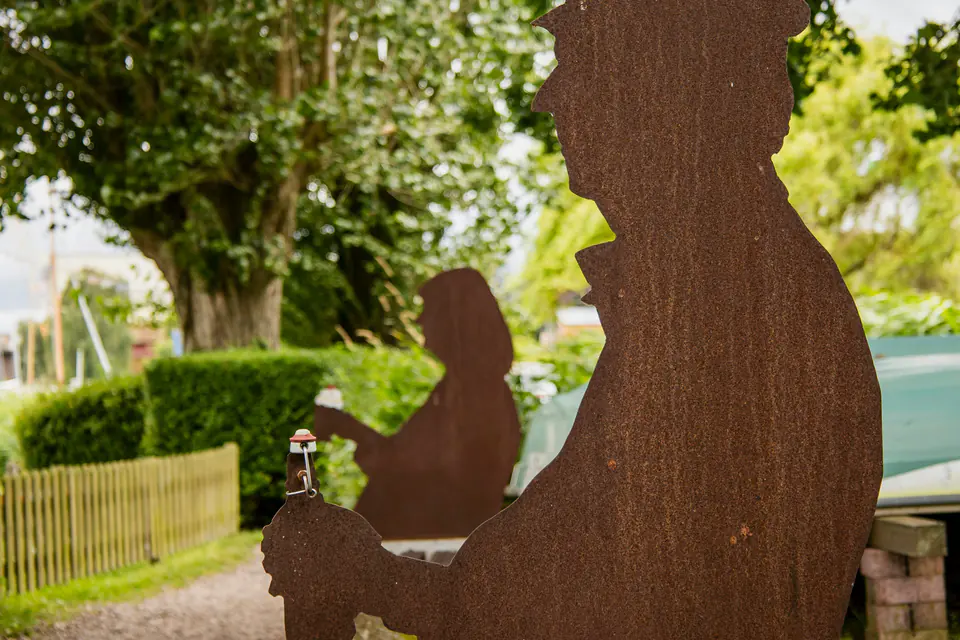
A plasma-cut piece starts as a drawing and ends as a slab of steel on a wall, a gate or a fence post. In between, a torch has to follow every line of the design, and some of what looks good on screen won't survive that. This guide covers the decisions you make when commissioning metal art: the artwork, the steel, the smallest details, the finish and how it will hang. If you settle these up front, the quotes you get will all be for the same piece.
For how fabricators price the cutting itself (per inch, per pierce, setup), see our plasma cutting cost guide. This post is about getting the piece right.
Start with artwork that works as a stencil
Plasma art is a silhouette. Everything that stays attached to the steel is one connected shape, and everything cut away is a hole. That has three consequences for your design.
Islands fall out. The middle of an "O", "A" or "R", or a bird's eye, drops out of the sheet when its outline is cut. To keep it, the design needs a bridge, a strip of steel tying it to the surrounding metal. That's why stencil fonts exist. Ask the maker to add bridges, or pick a font and art that already have them.
Everything has to connect. A landscape with trees, a skyline or a family name over a scene must be one piece of metal. Thin connecting branches and fence rails hold it together. If a part only touches the rest at a single point, it will be weak or fall away.
Lines become kerf. The torch removes a strip of metal as it cuts. Very close lines merge, and a thin sliver between two cuts may burn away. Leave space between features.
The cleanest starting point is a vector file (DXF or SVG) at 1:1 with closed paths. If you only have a photo, a sketch or a logo PNG, say so. Many makers will redraw it, and our CNC FAQ notes that this is quoted as design time.
Choosing the steel gauge
Sheet steel is sold by gauge. A higher gauge number means thinner steel. Standard mild-steel thicknesses, from a published gauge chart:
| Gauge | Inches | Millimetres |
|---|---|---|
| 18 | 0.0478 | 1.214 |
| 16 | 0.0598 | 1.518 |
| 14 | 0.0747 | 1.897 |
| 12 | 0.1046 | 2.656 |
| 11 | 0.1196 | 3.038 |
| 10 | 0.1345 | 3.416 |
How to think about it for art:
- Thinner sheet is lighter, easier to hang and less costly in material. It can flex or warp from heat on large pieces with a lot of detail, and thin bridges bend if someone grabs them.
- Thicker sheet is stiffer and survives knocks, wind and freestanding use. It's heavier, slower to cut and costs more in steel. It also limits how small your details can be (see below).
Indoor wall art and outdoor pieces have different needs. A garden sculpture, a gate panel or anything freestanding needs more stiffness than a sign screwed flat to a wall. Tell the maker where the piece will live and how big it is, and ask which gauge they'd pick and why. If you have a gauge in mind, put it in the brief. Our CNC brief checklist uses "14-gauge steel" as an example of what to specify.
Minimum feature size: the detail limit
Plasma can't cut arbitrarily small holes. A rule of thumb from plasma-system maker Kjellberg is that the smallest hole is "approximately one and a half times the plate thickness". Their example is a minimum of 15 mm in 10 mm plate. Their newer cutting technology does better on thick plate, and results vary by machine, so treat this as a starting point to discuss rather than a spec.
What that means for your design:
- Holes and eyes need to be comfortably larger than the steel is thick. A thicker gauge raises that minimum.
- Bridges and thin strokes need width too, or they'll burn through or droop from the heat.
- Text needs a size floor. Tiny lettering in a family sign is a common reason a maker sends a design back.
Ask the maker to check your file for features below their machine's minimum before quoting. Many will mark up a proof showing what they'd thicken or simplify. Approve a proof before cutting, especially for names, dates and logos.
Finishes: rust, paint or powder coat
Raw steel straight off the table has dross (re-solidified metal) on the back edge and mill scale on the surface. Then you choose how it should age.
| Finish | Look | Outdoors | Notes |
|---|---|---|---|
| Raw | Grey steel | Rusts | Cheapest; fine if you want it to weather |
| Rust patina | Deliberate orange-brown | Keeps rusting unless sealed | Rust can stain walls, decks and paving below |
| Clear coat | Steel or rusted look preserved | Needs upkeep over time | Locks in a patina |
| Paint | Any colour | Needs good prep and primer | Easy to touch up |
| Powder coat | Even, tough colour | Durable | Often sent out to a coating shop; adds cost and lead time |
Two questions to ask the maker:
- Who does the finish? Many fabricators send powder coating to a separate shop. That affects the timeline, and some coating shops have minimum batch charges.
- Are the edges cleaned first? Grinding off dross and sharp edges before finishing makes the piece safer to handle and helps coating stick.
If the piece will rust on purpose, say what is underneath it. Runoff from weathering steel stains concrete and pale stone.
Mounting and installation
Mounting is easiest to get right in the design file, before anything is cut. Common options:
- Standoffs. Threaded studs or spacers welded or bolted to the back so the art floats off the wall and casts a shadow. Say how far off the wall it should sit.
- Keyhole slots cut into the design, hidden behind solid areas.
- Tabs or holes for screws, placed where they don't break the design.
- Stakes or posts for garden pieces, welded on or bolted through.
- Frames for gates and fence panels, with the hinge side noted.
Put the wall or post material in the brief (brick, siding, wood fence, masonry) and roughly how much wind the spot gets. A large flat panel catches wind like a sail.
The brief
What it is: (wall art, house sign, gate panel, garden piece)
Artwork: (DXF/SVG at 1:1, or image + "please redraw")
Finished size:
Gauge or thickness: (or "maker to advise")
Indoor or outdoor; what is beneath it:
Finish: (raw, rust, clear, paint colour, powder-coat colour)
Mounting: (standoffs and depth, keyholes, stakes, frame)
Proof needed before cutting: yes
Quantity:
Date needed, and pickup or delivery:
Budget range:
Fabricators with plasma tables bid on CNC machining services on The Spool List, so you can compare price, lead time and past metal work on the same brief.
FAQ
Can a maker cut art I found online? Only if you have the right to use it. Makers may ask for permission on logos and characters you don't own, and some will decline.
How large can a piece be? It depends on the maker's table. Put the finished size in your post so only makers whose table fits will bid. Oversize pieces can be cut in sections and joined.
Will it be sharp? Plasma edges can be sharp and carry dross. Ask for edges ground and deburred, especially for anything at hand height or near children.
Can I get the same design in several sizes? Yes, but scale changes the detail limit. Small holes in the big version may be too small in the small one, so ask the maker to check each size.
Post your metal art brief free on The Spool List and compare bids from plasma fabricators.